
Advanced Treatments and Procedures
Minimally invasive therapies that target chronic foot and ankle pain by supporting your body’s natural healing.
What You Need To Know
A closer look at the advanced options available for lasting foot and ankle relief.
Modern Options for Foot and Ankle Care
University Foot and Ankle Institute offers a range of advanced, minimally invasive treatments designed to address chronic foot and ankle conditions. These therapies provide alternatives to traditional surgery, focusing on stimulating the body’s natural healing processes while minimizing downtime.
Many procedures target chronic tendon and soft tissue pain. The TenJet Procedure is an ultrasound-guided treatment that uses a pressurized saline jet to remove damaged tissue in conditions like Achilles tendinitis, plantar fasciitis, and peroneal tendinitis. The Topaz Procedure uses radiofrequency energy to create tiny perforations in damaged tissue, increasing blood flow and breaking up scar tissue. Both are outpatient procedures completed in under 30 minutes.
For patients with arthritis and soft tissue injuries, regenerative options include stem cell therapy, amniotic stem cell therapy, and SoftWave tissue regeneration therapy. SoftWave uses high-energy sound waves to enhance circulation, activate stem cells, and support tissue regeneration. Stem cell therapy uses cells from the patient’s own bone marrow or fat tissue to reduce inflammation in damaged joints, tendons, and ligaments.
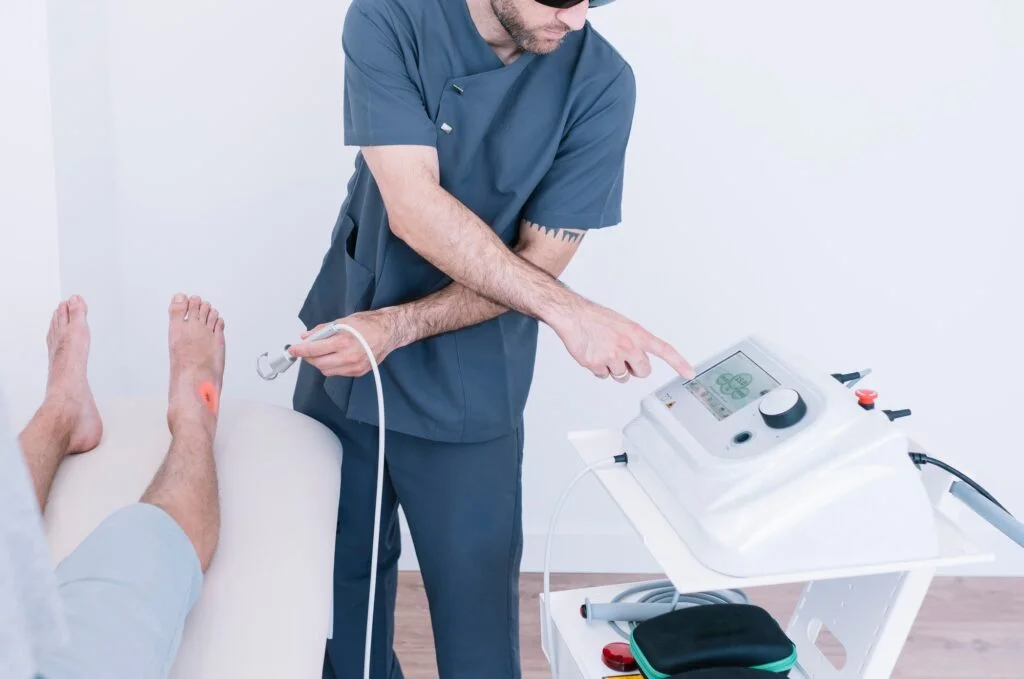
Additional options include Leneva, an injectable allograft that restores lost padding in the ball of the foot, Botox injections for plantar fasciitis, compression and collagen therapy for chronic wounds, and FX635 low-level laser therapy for chronic pain.
If conservative care has not resolved your pain, schedule an evaluation with one of our podiatrists to discuss which advanced treatment may be right for you.
Diagnostics and Surgical Options
Accurate diagnosis guides every treatment plan. Diagnostic ultrasound is a non-invasive imaging technique that uses a probe to create detailed images of soft tissue in the foot and ankle. It can visualize the ligaments, Achilles tendon, plantar fascia, posterior tibial tendon, and peroneal tendons, giving your podiatrist the information needed to direct treatment. MRI imaging may also identify bone edema, which can point to microfractures as the source of chronic pain.
When bone-related pain is confirmed, subchondral stabilization offers a minimally invasive option. The subchondral bone sits below the cartilage and acts as a shock absorber. During the procedure, a bone substitute material is injected to stabilize bones affected by defects, lesions, or fractures, and is gradually replaced by new bone as healing progresses.
When conservative care does not resolve the problem, your podiatrist may discuss surgery. Common procedures include bunion surgery, hammertoe correction, fusions for arthritis, heel spur removal, neuroma removal, and tendon repair. Reconstructive surgery may be recommended for severe deformities and can involve shifting of bones, tendon lengthening, foot fusion, or external fixation.
Minimally invasive foot surgery uses very small incisions and specialized instruments on an outpatient basis. Benefits include less soft tissue injury, less pain, shorter surgery times, less anesthesia use, and smaller scars. Following your post-operative instructions, including rest, ice, compression, and elevation, gives you the best opportunity for a smooth recovery.
Related Services
Locations Offering Advanced Care
Find a University Foot and Ankle Institute office near you for advanced treatment options.




Ready to find relief? Let’s talk about the advanced options that could work for you.
Our team is here to help you get back on your feet with care that fits you.