Corns and Calluses Treatment Care
Relief from painful thickened skin on your feet, with treatment plans built around your comfort and lifestyle.
What You Need To Know
Understanding corns and calluses, why they form, and when to see a podiatrist.
Understanding Corns and Calluses
Calluses and corns are skin problems often found on the feet. A callus is a thick, hardened area of skin that protects the foot from friction, often found on the ball of the foot, the heel, and under the big toe. A corn is a small circular thickened lesion in the skin, usually forming due to repeated pressure such as the rubbing of a shoe. The name comes from its resemblance to a kernel of corn. A corn differs from a callus in that it has a central core of hard material.
Many people use the terms interchangeably, but they are two different things. Corns are smaller than calluses and feature a hardened bump in the center, usually developing on non-weight-bearing areas like the sides or tops of your toes. Calluses develop on the heels, balls, or soles of your feet, are typically larger, and usually are not painful. Hard corns are found on firmer areas of the foot, while soft corns are found in moist areas, such as between the toes.
Telltale signs include a thick, raised area of skin, a hardened or rough bump, tenderness or pain, and waxy or dry skin. Over time, a corn or callus might also start flaking or shed layers of skin.
Both growths are caused by excess pressure and friction, often from shoes that are too tight or too loose, going barefoot in shoes, repetitive activities, or foot deformities such as hammertoes, bunions, flatfeet, or bone spurs. If your corn is extremely painful, bleeding, draining pus, or if you have diabetes or poor circulation, we recommend you seek professional help from one of our board-certified podiatrists.
Treatment and Prevention Options
If your corns or calluses are mild, reducing friction may help. Different shoes, moleskin patches, or soft pads may be all the treatment you need. At home, you can soak feet in warm, soapy water and then rub the thickened areas with a pumice stone or foot file. Apply a moisturizing lotion every night and cover with a loose sock. Over-the-counter moleskin or pads (without salicylic acid) can ease pressure.
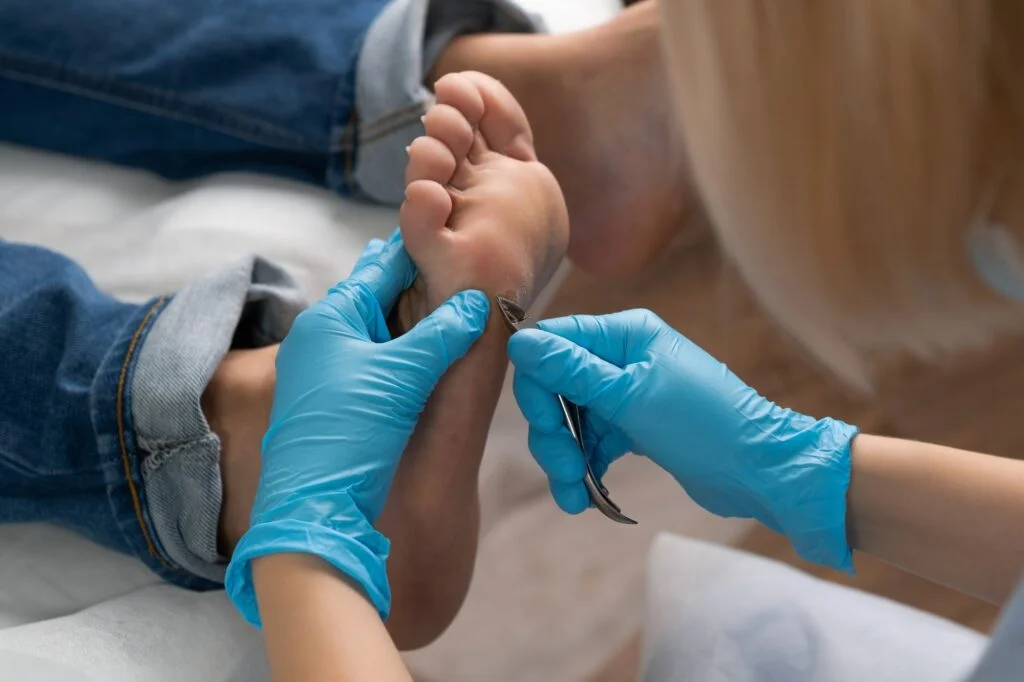
When conservative care is not enough, professional treatment can help ease symptoms and eliminate the skin growth. Your doctor may shave the surface of a callus, or trim away the outer layers of skin that make up a corn. For a painful corn, medication may be injected beneath the built-up tissue. An exfoliant such as a cream with urea can remove dead skin, and an oral antibiotic can clear up any sign of infection.
If your callus or corn is caused by your gait or foot structure, custom-fitted orthotics can greatly ease friction and pressure. Orthoses are made to meet the needs of your feet, cushioning calluses or diverting pressure away from problem areas. Worn as directed, they help limit existing problems and prevent new ones.
If a bone or joint is out of place, surgery is often the best way to correct the problem. This is typically an outpatient procedure, and your doctor will discuss the option best suited to your needs. You can help prevent recurrence by wearing well-fitting shoes with plenty of toe room and washing your feet daily. With your doctor’s help, corns and calluses can be controlled.
Find Corns and Calluses Care Near You
Our board-certified podiatrists treat corns and calluses at locations throughout the area.




Don’t let painful corns or calluses slow you down any longer.
Our board-certified podiatrists are ready to help you get back on your feet.