Flat Feet Care and Custom Orthotics
Relieve arch pain and prevent long-term damage with expert flat feet care, custom orthotics, and bracing options.
Understanding Flat Feet
What flat feet are, why they happen, and how we help you find relief.
Flat Feet: Symptoms, Causes, and Care
Flat foot is a common condition where the foot’s arch is flattened and the entire sole of the foot touches the ground when standing. The arch of your foot is its main supportive structure. If this arch loses strength, the bony framework begins to collapse, causing your foot to flatten. Like a sagging bridge, the weakness in the middle strains the joints at both ends.
There are several types of flat feet, all sharing partial or total collapse of the arch. Other traits include toe drift, in which the toes point outward, the heel tilting outside, and the ankle turning in. A tight Achilles tendon, bunions, and hammertoes may also develop. Flexible flatfoot typically begins in childhood and progresses through adulthood. Adult acquired flatfoot, also known as posterior tibial tendon dysfunction, most commonly affects women after age 40 and worsens in stages. Pediatric flatfoot occurs when the longitudinal arch does not develop normally in a child.
You may have no symptoms, but flat feet can cause easily-tired feet, aches in the arches and heels, difficulty standing on tip-toe, hip, leg and back pain, and swollen soles. Discomfort often doesn’t appear for years, then walking may become awkward as strain builds on your feet and calves.
Some people are born with flat feet. Others acquire them through arthritis, trauma, or musculoskeletal disease, and overuse on hard surfaces can weaken the arch. If you notice pain or changes in your foot, schedule an evaluation so we can review your history, examine your gait, and build a treatment plan that fits your needs.
Treatment Options for Flat Feet
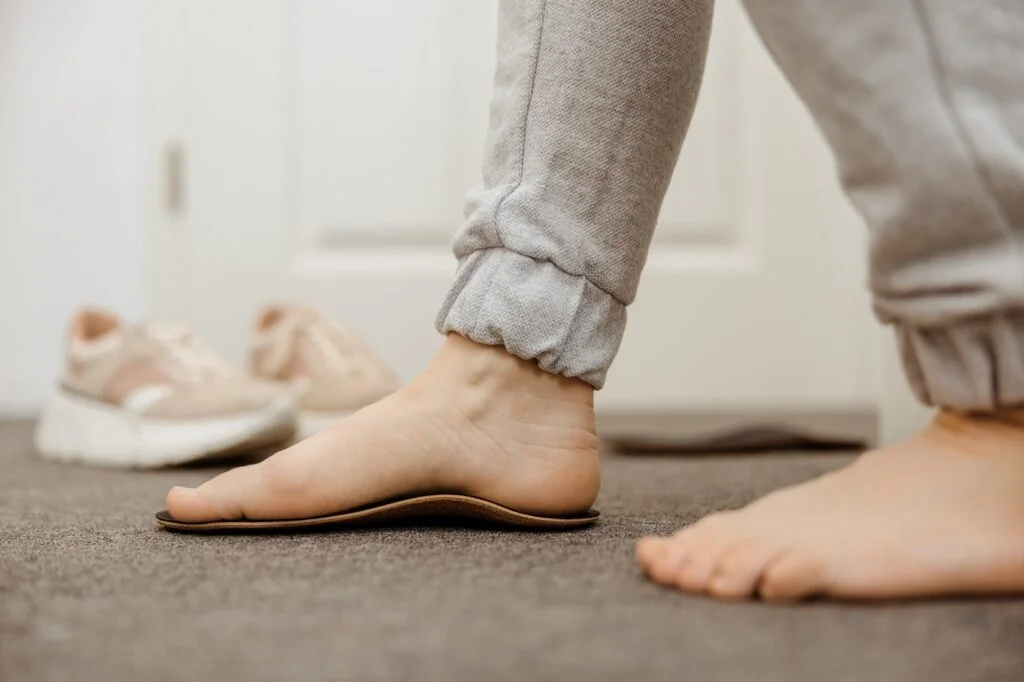
If flat feet are diagnosed early, nonsurgical treatment can often help. Conservative care includes stretching exercises, physical therapy, icing, supportive taping or bracing, anti-inflammatory medication, custom-fitted orthotics, and supportive shoes. Custom orthotics readjust the weight-bearing position of your feet, with soft, semi-flexible, or rigid inserts chosen based on your weight and activity.
When pain and misalignment do not resolve with conservative care, the EOTTS-HyProCure procedure may be an option. EOTTS stands for extra-osseous talotarsal stabilization. This minimally invasive procedure places an FDA cleared titanium stent into a naturally occurring space between the ankle and heel bones called the sinus tarsi. There is no drilling or cutting. The stent stabilizes the joint while still allowing normal hindfoot motion, can be performed on children and adults, and is reversible if needed.
Advanced adult acquired flatfoot may require reconstructive surgery. Depending on the stage, this can involve tendon transfer, osteotomy of the heel bone, lateral column lengthening, gastrocnemius recession, or arthrodesis to fuse joints and stabilize the foot. In pediatric flatfoot reconstruction, joint sparing procedures are favored to maximize future function.
At home, ease symptoms by stretching your soles and tendons, wearing supportive shoes with room in the toe box, and using warm-water soaks or ice massages. If you have diabetes or a circulation problem, talk with your podiatrist first, then follow up with us to confirm the right long-term plan for your feet.
Flat Feet and Orthotics Care Near You
Find a University Foot and Ankle Institute location offering flat feet care close to home.




Don’t let flat feet slow you down, let’s get you walking comfortably again.
We’re here to help with expert care, orthotics, and treatment that fits you.