
Ultrasound Guided Injections Therapy
Precise, image-guided injections that deliver medication exactly where it is needed for safer, more effective relief.
What You Need To Know
How ultrasound guidance improves the accuracy and comfort of injection therapy.
Ultrasound Guided Injection Therapy
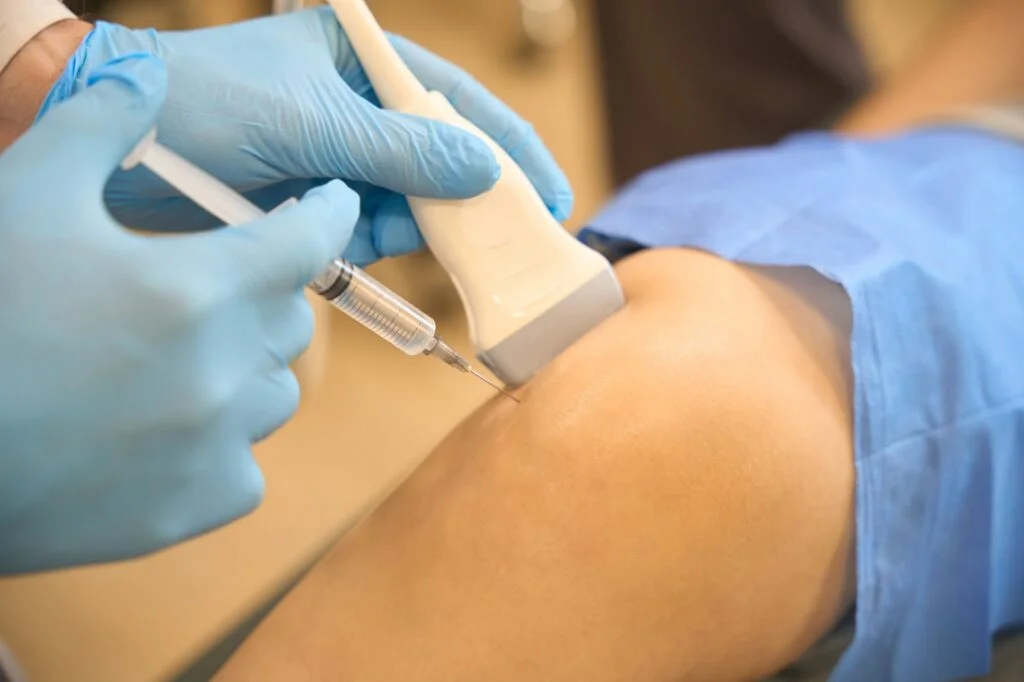
Diagnostic ultrasound is used today to provide doctors with the ability to see where an injection is going, ensuring that medication is delivered directly to the exact spot where it is needed. Delivering medication directly to the target area avoids damaging surrounding tissue and prevents placing the medication in areas where it will be less effective.
Diagnostic ultrasound use was first reported in 1958 as a reliable method to evaluate musculoskeletal structures. Since that time, its use has become increasingly popular in the medical world. Today, physicians use ultrasound technology to clearly visualize soft-tissue structures for pending treatment. The tissues most commonly viewed are tendons, ligaments, and muscle. There are also instances where arteries and nerves are viewed.
We all realize that receiving an injection is sometimes necessary to treat specific injuries or conditions. Having the medication delivered directly to the exact location ensures the best possible result. Having the ability to see where the injection is going provides a better outcome, because the doctor is able to precisely deliver the medication exactly where it must go.
The doctors at University Foot and Ankle Institute have available and frequently use diagnostic ultrasound in delivering treatment to our patients, ensuring the safest, most effective, and comfortable treatment possible. If you are considering an injection for foot or ankle pain, schedule a consultation to learn how ultrasound guidance can improve your care.
PRP Therapy with Ultrasound Guidance
Platelet-Rich Plasma (PRP) therapy uses a patient’s own blood to stimulate healing and tissue regeneration. The process involves drawing a small sample of blood, separating the platelets and growth factors through a centrifuge, and then injecting the concentrated healing properties directly into the affected area. PRP has been widely used to treat conditions such as plantar fasciitis, Achilles tendinitis, arthritis, and other musculoskeletal injuries.
Platelets are a blood component often associated with clotting, but they also play an important role in recovery by secreting proteins that stimulate cell growth. PRP is exactly what the name implies: plasma with more than the usual concentration of platelets. PRP can have five to ten times as many platelets as normal plasma, so that is potentially a lot of healing power.
Here is what to expect with PRP therapy: an initial consultation to determine if PRP is right for you, a blood draw and centrifuge processing, an injection into the affected area, and a short recovery period where mild swelling or discomfort may occur. Some patients notice improvement within a few weeks, while others may require multiple treatments for optimal results.
PRP is non-surgical, minimally invasive, and derived from your own blood, which lowers the risk of rejection or allergic reaction. Pairing PRP with ultrasound guidance helps ensure the concentrated platelets reach the exact tissue that needs repair, supporting a smoother recovery and lasting pain relief.
Locations Offering Guided Injections
Find a University Foot and Ankle Institute location near you for image-guided injection care.


Ready to get precise, targeted relief from foot or ankle pain?
We’re here to help you feel better. Schedule your consultation today.